2. I discovered a secret. If you start your project by A/B’ing your commercial reference recordings to each other, it will not only open up amazing insights and increase your ability to hear things
you’ve never heard before, but will boost your confidence tremendously. Boosting your confidence, will, all by itself, help you raise the quality of your mixing and mastering by leaps and bounds. Mixing is, for the most part, a mental sport.
You can easily and completely become mired down with your attention focused on the what “hit-makers” are using, what equipment they have, and what exact
plug-ins and VST instruments they choose. The objective, unfortunately, becomes trying to use what they use, have the same equipment they have, and make the same choices in plug-ins and vst instruments they make, thinking all this will result in great mixes and masters. It won’t.
What will make your mixing and mastering consistently great is accomplished by:
A. Learning how to listen objectively to your own mixes. (All the, blogs, videos and courses on music production available on HowToLicenseYourMusic.com are designed to help you accomplish exactly that). This will inevitably lead to:
B. Consistently raising your confidence in being able to mix and
master your music to radio-ready standards. A confident mixer is going to make good decisions and choices without “second guessing.”
In other words, it’s not about learning what experts have and what experts are doing.
It’s about your perception of what you are doing with what you already have, and how to sharpen and enhance your
perception. (assuming you have at least a basic home studio set-up) I call it ear training for producer/engineers.
Trying to duplicate equipment and mimic actions does not produce a brilliant producer/engineer. Increasing your confidence by sharpening and enhancing your knowledge, experience and perception increases your confidence and turns you into a brilliant
producer/engineer.
What you hear from most “hit-makers” online (most of them are endorsed by at least one plug-in company, or DAW manufacturer, or VST company), isn’t what you hear behind the scenes when no cameras are rolling. The truth sounds something like this, “I don’t really care what equipment I’m using, what DAW I’m using, what speakers I’m using. As long as they work, I can make a
hit.” That’s the truth. And that’s the kind of confidence I’m helping you build in yourself.
Ok, before my next blog (which will be a video blog showing A/B’ing in action during actual mixing and mastering sessions), I’m going to prepare you by laying out, in detail, the six different scenarios of A/B’ing for a producer/engineer. You’ll end up with the best quality tracks if you use
all of them.
Scenario 1 Reference Tracks To Reference Tracks
In my opinion, this is the most important scenario:
Carefully choose three commercial reference tracks
similar to your project and A/B them to each other, listening closely for aspects of the arrangements, mixes, performances that you especially like and what aspects are not your favorite. From this you can more closely define the vision for your recording. This step produces amazing positive phenomena within you, sharpening your perception, allowing you to hear things in these recordings you never heard before, and most importantly, boosting your confidence markedly. You may find
that one track has too much bass for your taste, though the rest of the mix you love. You may find that one track is overall a lot brighter than the other two. You may find that one track sounds thinner in the mid-range than the other two, etc. Things you never heard before. All of these things you’ve never heard before will help you arrive at one important conclusion: Mixing is not just a Science. It’s an Art. These commercially released productions are produced by humans, just like you, who
have strengths, weaknesses, preferences, and limitations. I’ve watched students go through this process many times. Every time, a similar thing comes out of their mouth. “Wow, I heard things in these tracks I’ve never noticed before.” And then the most important statement follows: “I can do this. I know exactly what I want my track to sound like now.”
Scenario 2
Individual Mix Elements
Get a hold of individual mix elements and A/B those elements to the individual tracks you are mixing. For example, A/B’ing your kick drum to a kick drum from a commercially released mix. Lead Vocal to Lead Vocal, Background Vocals to Background Vocals. Bass to bass. Guitar to guitar, Synth to synth, etc. Since individual mix
elements are rare, I’ve made a library of mix elements available to you for free. Email me at gary@learnaudioengineering for your free library.
Scenario 3 Groups/Stems
A/B your Drums/Percussion tracks to commercially mixed Drums/Percussion. Guitars to Guitars, Basses to basses, Orchestration to Orchestration. These “groups” are
the same thing as a “stem file.” This step basically involves A/B’ing your “stems” to commercially recorded stem files. This will give you great insight into how you are perceiving your mix as you build up its foundation. In your free reference library package, you’ll also be receiving stem files.
Scenario 4 Mix to Mix (or Mix to Master)
Scenarios 1, 2 and 3 are rarely done by most people, though they produce amazing results. This scenario 4, Mix to Mix (or Mix to Master) is done more often. However, there are details about how to A/B a mix which are vital for you to know in order to produce radio-ready results consistently. For instance, when A/B’ing your mix to a commercial recording. You are actually comparing apples to oranges: your mix (A) to a commercial master
(B). In order to make it apples to apples, it’s vital that you lower the volume level of the commercial master to the same volume level of your mix. It’s often necessary to “reverse engineer” the commercial recording back into its “mixed state” by cutting just a bit of the lows and cutting just a bit of the highs (both highs and lows get boosted during the mastering process), in order to approximate “apples to apples” even more closely. If possible, try to get your
hands on actual mixes, prior to mastering, of commercial recordings to use for your reference files. Good news here as well, is that I have pre-mastered commercially released mixes available as part of the free reference library. Again, just send me an email and its yours. For a detailed look at actual mixing sessions using these techniques, check out the course “Music Production FundaMENTALs,” available as one of three free music production courses when you sign up for the 180 Day Music
Licensing Challenge.
Example Of A/Bing
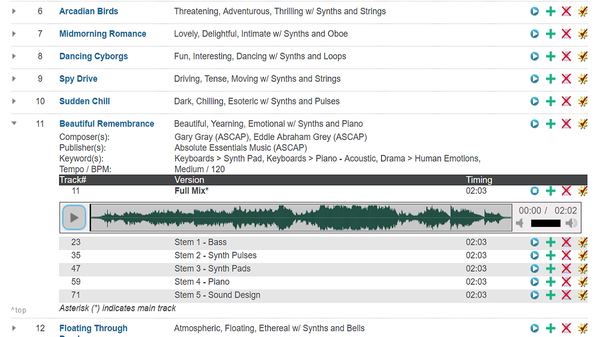
For this particular track, “Beautiful Remembrance,” I used three tracks for A/B’ing, one called “Heaven,” which had been released by Megatrax, the Intro to Adele’s “Hello,” and the intro to Norah Jone’s “Come Away With Me.” Since these three tracks were all commercial
masters, I used the Mix to Master techniques described above.
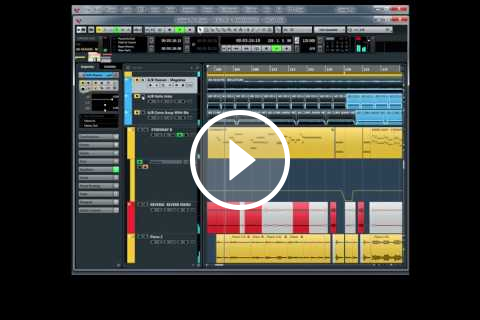
Check out a 30 second excerpt of an A/B session for this track here: