In my recent podcast with Emmy
Award winning songwriter Michele Vice-Maslin, who has had over 5,000 placements in tv shows, films and ads, Michele stated that she works 15 to 16 hours a day, six days a week and takes Sundays off. I don’t know if Michele works this schedule every week, or if she was simply giving me an idea of how often she sometimes works to achieve the level of success she’s achieved. Michele is incredibly accomplished as a songwriter and in the world of licensing and I’m not surprised to
hear how much work goes into her career.
If you haven’t already, be sure to check out the podcast I did with Michele, it’s one of my best yet.
Our conversation really got me thinking though
about just how much work being a successful musician in 2017 requires. Michele also said in our interview that on average, she lands one placement for every thousand pitches she makes. In the last 25 years she’s had over 5,000 placements. That’s a lot of time spent pitching music!
Michele said in our interview that being a musician is so hard that she’s known a lot of musicians over the years that have quit and gone on to other careers that are less competitive and offer more
stability. I’ve known plenty of aspiring musicians over the years as well that have changed career paths and pursued more conventional ways of making a living. Being a musician isn’t for everybody and if the pain of trying to make a music career happen outweighs the joy of being a musician for a sustained period of time, there’s no shame in making a decision to do something else in order to lead a more balanced, stable life.
But, how do you know when the pain you’re experiencing is
simply a temporary setback that can be overcome, compared to knowing when you’re simply on the wrong track and no amount of goal setting or hard work will get you to where you want to be?
Is there such a thing as a goal that is simply too hard to attain because the insane level of work and effort required to achieve it simply isn’t worth it? Obviously we can’t all do anything we want to do. For example, I’m pretty sure at my age and with my lack of athletic prowess, I could never
become a professional football player. As much as motivational speakers like to tell us we can all do anything we set our minds to and that if we can dream it we can do it, this simply isn’t true. Some goals are simply out of reach.
Knowing this, how can we distinguish between when we’re giving something up because we’re just too lazy or lack ambition, compared to quitting something because, despite our best effort, it’s simply not happening and we feel miserable as a
result? In other words, how do we know when to quit something vs. when to continue the path we’re on and keep going for it?
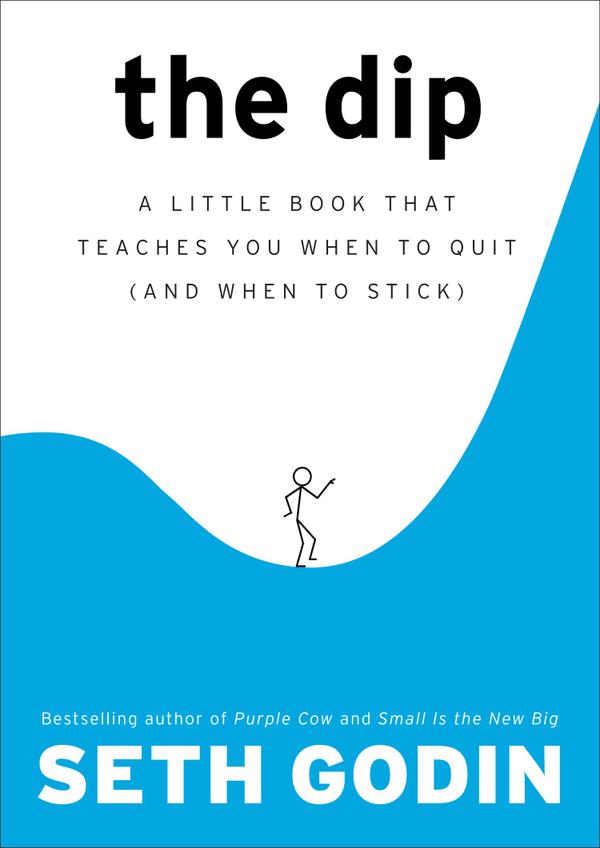
There’s actually a great book about this exact subject that I read recently called “The Dip” by Seth Godin.
It’s a short, simple book that breaks down when we should quit something that simply isn’t working for us versus when we should plow through the pain and setbacks we will inevitably confront on our journey to success.
One of the key points of the book is that contrary to popular opinion, quitting the right things at the right time is actually one of the keys to achieving success. To put it another way, if you stay on the wrong path long enough, you can actually prevent yourself from achieving success, since you’re spending time
and energy doing something that you’re probably never going to be successful doing. In other words, there is an opportunity cost to our decisions. Whenever we choose one path, by default we’re giving up all the other paths we could have taken. We need to choose wisely.
The title of the book, “The Dip”, refers to a phenomenon that anyone who embarks on any sort of meaningful and worthwhile endeavor will experience at some point. Whether you’re starting a band,
starting a company, launching a website, embarking on a solo career or fill in the blank and insert worthwhile objective here, you will experience “the dip”. The dip is when things get hard. The dip is when the fun and excitement of doing something inevitably wears off, but you still haven’t quite mastered what you’re pursuing and achieved the success you’re after. The dip is when some people make the correct decision to quit and it’s when others bail prematurely and
probably could have had success had they endured this period a little longer. The trick is knowing what to do when this period sets in. Should you stay or should you go?
Knowing whether or not to quit really depends on whether or not you have what it takes to make it through this “dip” period. If you’re trying to do something meaningful and worthwhile, it’s going to inevitably get hard at some point. This period is the barrier to entry that prevents others from
achieving the success you’re after. As Godin states in The Dip, “It’s human nature to quit when it hurts. But it’s that reflex that creates scarcity.” Of course scarcity creates value. The more scarce something is, the more valuable it’s perceived to be. If what you wanted to accomplish was easy, everyone would do it. If everyone could do it, it wouldn’t be that big of a deal.
So how do you know when to quit something you’ve started compared to knowing when to
continue and push through the painful period of struggle that inevitably comes? Godin sums it up this way, “The decision to quit or not is a simple evaluation: Is the pain of the Dip worth the benefit of the light at the end of the tunnel?”
Should You Quit Music?
Seth Godin’s book, The Dip, provides some great things to think about and contemplate as it relates to pursuing worthwhile goals, like a career in music. However, real life isn’t always as clear
cut as authors like Godin like to make it out to be. We don’t always know what lies on the other side of our efforts. How do we really know if we push through the painful difficult periods that success will actually be waiting for us on the other side? How long should we wait until we move on to something different? How can we tell when we’re on the right track?
These aren’t easy questions to answer and there aren’t always clear cut ways to determine what the right
choice is, but one of the ways we can get a sense of whether we’re on the right path is to look at others who have come before us. How long did it take them? What did their trajectory to success look like? This isn’t a perfect barometer of course, but as Tony Robbins has stated, “success leaves clues”.
This is one of the main reasons I do my podcast and interview different people in the music business on a weekly basis. I want to know their stories. I want to know what it really takes to succeed. Everyone I interview has a different story. No two paths are exactly like. That’s one of the exciting, albeit challenging, things about the music business. There is no formula. What works for me might not work for you, and vice versa. However, if you speak to enough
people in the industry that are succeeding on any sort of significant level, you start to see some commonalities. There are places where most success stories overlap.
One of the common themes that ties all the success stories together of people I’ve interviewed over the last few years is that they both really, really love making music and they’re willing to work extremely hard to achieve their goals. Like crazy hard. Succeeding doesn’t mean that every moment of every day
is filled with ecstasy and bliss. I doubt this is ever the case for even the most “successful” musicians. But what it does mean, is that the moments of elation and joy you do experience, at some point, make the pain and frustration of the dip worthwhile. In other words, you’re willing to pay the price that success inevitably costs because it’s worth it. If the price isn’t worth it, then why pay it?
An Alternative To Quitting: Pivoting
In the past I’ve
considered quitting music when I was in a fairly severe dip, when things didn’t seem to be working out at all. This period was in my early thirties, after a decade or so spent playing in bands that didn’t go very far, or at least didn’t go as far as I would have liked. I felt burnt out and frustrated and for a time I considered quitting music altogether.
Instead of quitting though, I modified my course. I decided to continue playing and pursuing music, but at the same
time I incorporated some “safety nets” into my plan. I developed a few different revenue streams all connected to playing and writing music, and simply continued my path as a songwriter and performing musician. This modification in my approach to music, freed me up to pursue music in a way that isn’t quite so intense and anxiety inducing. It lowered the price I had to pay, if you will.
These days I make a good portion of my income directly from music. I perform
regularly. I have fairly stable licensing income. I also make money from my various websites and courses. Together, these different income streams provide a level of security that allows me to continue to make music from a place of peace and calm.
Have I “made it”? I guess that depends on how you define making it. In a way I feel like I have, in the sense that I support myself doing things that, for the most part, I enjoy doing. But I still have much
larger goals that I’m chasing, so in that sense, I still have a long way to go. And, I’m ok with that. Part of the fun is the journey, and as long as I’m able to provide for myself and meet my needs, I’m happy to keep fighting the good fight.
I’ll never quit music, because I’ve set my life up in a way where I’m not forced to make an all or nothing decision. But I also have enough of a vested interest in my continued success as it relates to my own music career and music
business career, that I’m highly motivated to keep going and keep pushing things. This balance works out great for me. I know that no matter what, I’ll figure out a way to continue to provide for myself and my loved ones, but I also know that I can’t get too complacent and give up on my dreams and goals. To a large extent, my business and income depend on continuing to push myself and others, to find continued success.
What about you? How do you balance pursuing and/or
growing your career in music and maintain your sanity and happiness? Are you experiencing a dip now or in the past? And if it was in the past, how did you overcome it? How are you able to push through your hardest moments? Where do you draw inspiration from when things get tough? |
|
|