When I was in LA a few weeks ago with my producer, Gary Gray, Gary asked me a hypothetical question. If you had a billion dollars, Gary asked, what would you do to fix the recording industry? I thought about it for a few seconds, and unable to come up with a satisfactory answer, I joked that if I had a billion dollars I would spend enough money on promotion and recording to make myself famous and then keep the rest. Screw the recording industry I joked! After all, if I had a billion dollars that would surely be enough to put myself on the map, one way or another. With that kind of money I would just function as my own record label and pay for all the promotion needed to make myself famous. With a billion dollars that would be easy. But fixing the recording industry, that’s a little more challenging and requires a lot more thought.
Well, I’ve thought about this question a lot since then. It’s a fun intellectual exercise to spend time thinking about issues that are this big. After all, the recording industry is in dire need of fixing, I think we can all agree on that. The sale of recorded music has declined dramatically over the last two decades. Digital downloads were expected by many analysts to make up for the decline in CD sales, but that simply hasn’t happened as more and more consumers are shifting to streaming music. Streaming music is up, but that really isn’t great news for most musicians since streaming music doesn’t really equate to substantial revenue for the vast majority of musicians.
The Internet Killed The Recording Industry
Let’s face it, the internet is an amazing invention and I couldn’t imagine my life without it these days, but it’s destroyed the recording industry. It’s simply way too easy to find your favorite song and stream it, or listen to it on youtube, or download a pirated copy of it. In other words, it’s way too easy for consumers to listen to music they like without really paying for it. It’s simply supply and demand economics. There’s an enormous supply of music, and most of it can be listened to for free.
In the old days, if you heard a song you really liked on the radio, you either had to wait until your favorite radio station played it again, or you had to go to your local record store and buy the album, tape, eight track, CD, etc. There weren’t many other options. Sure, you could have your friend make you a bootleg copy, but it wasn’t nearly as easy to listen to music you liked on demand without someone actually paying for it. It was either you or your friend, but someone was buying the record.
These days a kid in Iowa can download a CD to his hard drive and upload it to the internet in a few seconds, where millions of people around the world can listen to it for free. Or, if they’re real music fanatics they can do what my friend Greg, who considers himself a die-hard music fan just did, and buy a membership to Spotify. For 99 cents for the first three months and $9.99 thereafter Greg now has access to millions of songs. For less than the price of what it used to cost to buy a single CD, my friend can now access Spotify’s entire library of like a gazillion songs. Let that sink in.
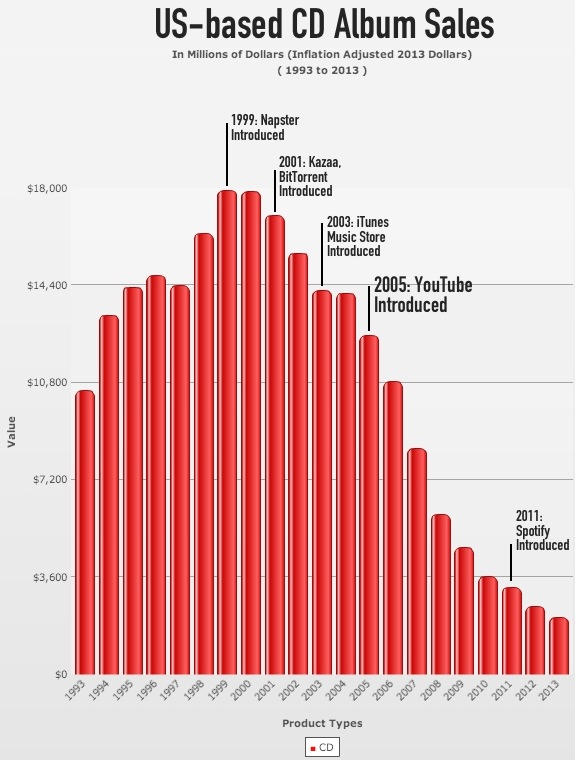
Here's a graph showing the decline in CD sales over the last twenty years and how it correlates to the advent of the internet and internet related technologies.
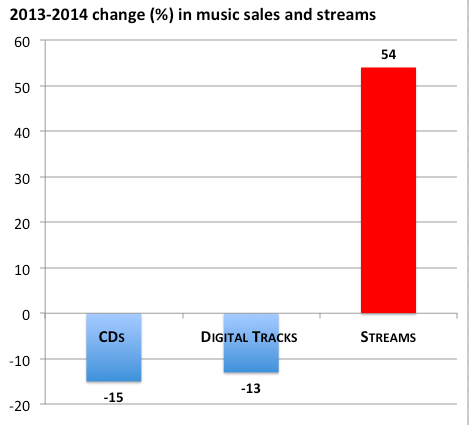
It's important to point out that the sale of digital music is also declining. It's easy to make the argument that CDs have simply become obsolete and that CD sales are being replaced by digital downloads, but that's unfortunately not the case. Here's a chart I found on The Atlantic.com showing the decline in both CD and digital music sales for 2013 - 2014, along with the rise in streaming music.
Here's a quote from the same article I found the above graph in, "The Death Of Music Sales" about last year's music industry sales overall, "
Nearly every number in Nielsen's 2014 annual review of the music industry is preceded by a negative sign, including chain store sales (-20%), total new album sales (-14%), and sales of new songs online (-10.3%). Two things are up: streaming music and vinyl album sales."
Is it really any surprise that less people are buying music these days?
Of course, pinpointing the problem is a lot easier than finding the solution. It’s not that hard to figure out why the recording industry is struggling so much. But the solution? That’s a little harder to come by. After all, the internet isn’t going away anytime soon and you can’t force consumers to buy something they don’t want or need.
Humans are pretty easy to figure out when it comes to what motivates them to buy something. Most people simply want the best product, for the best price. Sure, there are a small percentage of thoughtful, conscientious consumers who think through their purchases and how their buying decision effects the big picture. But I think it’s fair to say that most consumers just want to buy what they want at the best price. Wal-Mart has been successful for the simple fact that they’ve been able to provide things that people want at a very competitive price. Most people aren’t thinking about how buying something from a store like Walmart is affecting small business owners in the same way that most people that are listening to music for free or close to free aren’t thinking about how it’s affecting the livelihood of musicians they love. In both cases, they’re just opting for the best price.
So, what’s the answer? How do we fix the recording industry? Well, if I knew the answer to that question I definitely wouldn’t put it out on some silly blog. After all, there’s a lot of money at stake. The recording industry is less than half of what it was twenty years ago. Anyone with the know how to fix what’s broken in the recording industry stands to make a gigantic fortune. If I knew the answer, I certainly wouldn’t spell it out here. I’m not saying that I do have the answer, but I think I can at least point you in the right direction.
Creating Demand
In order to fix the recording industry, we have to return to a time when there was an incentive to buy music. I can remember being a kid and listening to Casey Kasem’s top 40 and hearing songs that I liked and then rushing to the record store the next day to buy the 45 or the whole album. It was such a simple sales process. Play song on radio – listener likes song – listener buys album. It worked. Sure, there were problems and there were some unscrupulous record label executives that took advantage of artists. But it was a real industry that flourished for many years. There were huge advances given to unknown artists, there was money spent on development deals and when artists were successful, a lot of money was made by both the label and the artist. It was always a business for dreamers, but you could sense that if you were determined enough and hustled enough, anything was possible. All you had to do was look at the hundreds of bands that seemed to make it big every year.
These days, the recording industry is a fraction of what it once was. Record sales are less than half of what they used to be. Big advances to most artists are a thing of the past. The whole industry seems confused about what direction to go in and the last few years have given new meaning to the term “struggling artist”. Musicians and artists have no problem struggling and working as hard as imaginable to realize our dreams, but we need to know that there’s an industry there to support us once we’ve paid our dues. By industry I don’t necessarily mean major record labels, but simply that the business of recording and selling music is vibrant and healthy enough to sustain the musicians that are a part of it.
I’ve given this a lot of thought and I won’t spell out my exact ideas here. Who knows, maybe one day I’ll get around to fixing the recording industry, once I’m done solving the world hunger and world poverty issues. But think about this: what if there was a way to create a real demand for people to buy music again? What if when someone heard a song they liked, they had to actually buy the song or the album it was on in order to listen to it on demand, like in the old days, but using current technology. In other words, what if there was a way to create a demand for purchasing music again? What if there was no other choice? Do you think then people would start buying music again?
As I see it, the majority of the problems facing the recording industry boil down to this simple issue of supply and demand. People aren’t buying music right now for the simple reason that they don’t have to. Whoever can fix this fundamental problem, and by no means is it any easy problem to fix, will go a long way towards fixing the current state of the recording industry. We have to incentive paying for music again. We have to create an environment where it’s easier to pay for music than it is to listen to it for free. If we can do this, I’m convinced people will return to buying music, as the demand for music has never gone away. Consumers simply have way too great a supply of free music.
People are never going to stop loving music and listening to music, and musicians are never going to stop being inspired to create music. But the music industry needs to find a way to get people to buy music again. We can’t keep giving it away.
Share your thoughts here:
http://www.aarondavison.net/blog/how-to-fix-the-recording-industry